

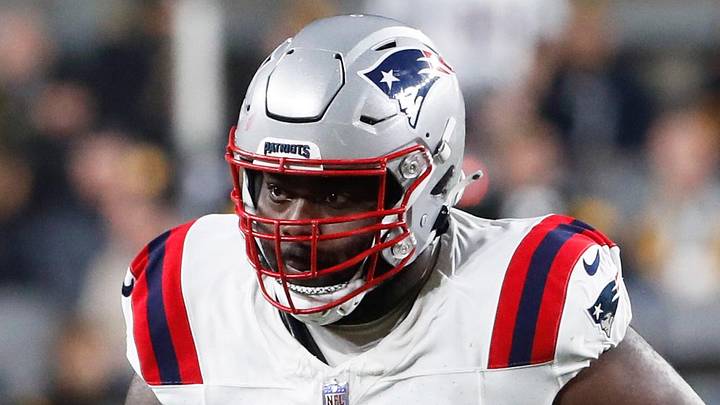
Michael Onwenu just turned in one of the best seasons of his NFL career with the Patriots. He played all 17 games at right guard, anchored an offensive line that allowed Drake Maye to become an MVP candidate, and helped his team win the AFC East at 14-3.
Pro Football Focus graded him as the fifth-best pass-blocking guard in the NFL last season. He earned $13.5 million in cash in 2025, which by any reasonable measure was money well spent.
The problem comes this year.
Onwenu is owed $17.5 million in cash for 2026, a figure that lingers from the three-year, $57 million deal he signed in March 2024. That contract paid him as a tackle, which is what he was playing at the time. With Will Campbell anchoring left tackle and Morgan Moses returning on the right side, Onwenu has since settled in at guard. And guards don't make the same kind of money as tackles.
You can see the proof in this year's free agency. Onwenu got $19 million in 2024 on a $255.4 million salary cap. This year, on a $301.2 million salary cap, free agent guards couldn't match his APY. David Edwards landed four years and $61 million from New Orleans, a $15.25 million average and $30 million guaranteed.
Alijah Vera-Tucker, signed by the Patriots themselves, got three years and $42 million, $14 million per year with $21 million guaranteed. Ed Ingram came in at three years, $37.5 million. Isaac Seumalo, John Simpson, and Zion Johnson are all in the $10 to $16.5 million APY range. The non-elite veteran guard market this offseason topped out at $16.5 million.
Michael Onwenu's value will be determining factor in his future with the Patriots
My contract modeling lands Onwenu's fair market value somewhere between $13 and $16 million per year, which puts his 2026 cash above what the market would pay for his next deal. That complicates a potential extension - something the 28-year-old New England stalwart is likely seeking.
The cleanest comp is Edwards. Both players are entering age-28 seasons. Both were Day 3 picks who developed into starters. The production comparison favors Onwenu. In 2025, he allowed a 3.24 percent pressure rate against Edwards’ 4.55 percent. He surrendered two sacks to Edwards’ three. He played 17 games to Edwards’ 16.
His Pro Football Focus run-blocking grade also came in higher at 74.2 compared to 69.0. If Edwards is worth $15.25 million per year on the open market, Onwenu can reasonably ask for $15.5 million on an extension.
And this is where the two sides hit an inflection point.
A path forward for an extension could be made easy
Onwenu can push for an extension this summer that locks in guarantees and sacrifices some APY. Some speculation has already started. Conversely, the Patriots can wait the market out and approach him late in the offseason with a different proposition entirely.
The first path borrows directly from the Eagles’ Lane Johnson playbook. Philadelphia has twice extended Johnson ahead of free agency, each time adding a single new year, converting old base salary to bonus, and giving him fresh guarantees on years that previously had little or no protection.
Applied to Onwenu, the deal would read as a two-year, $31 million extension at $15.5 million in new-money APY, in line with Edwards. Folded into his existing 2026 number, the full contract becomes three years and $48.5 million total with $25 million guaranteed.
The structure would likely reshape his cash flow, reducing his 2026 cash number to $15.5 million, a $2 million reduction from his current figure, with that money fully guaranteed.
The 2027 salary would come in around $16 million, with $9.5 million of it guaranteed, and 2028 would carry a $17 million salary with no protection. On paper, it is a two-year extension. In practice, the Patriots are signing up for 2027 and giving themselves a clean exit after that, because the guarantees run out before the final year.
The less likely option
The Patriots could run that same play on Onwenu. They could wait until July or August, watch the rest of the guard market settle, and then ask him to drop his 2026 cash from $17.5 million to something closer to $13 million. If he refuses, they cut him, eat $7.5 million in dead cap, and save $10 million while reallocating the snaps to someone cheaper.
Accepting the release would be a killer blow to Onwenu because it would be nearly impossible for him to get his fair market value that late in the offseason. So, the likely option for him at that point would be to swallow the pay cut.
The right call is the extension. The Patriots fielded one of the worst offensive lines in football in 2024 and have spent the last eighteen months methodically rebuilding it. They used the fourth overall pick in the 2025 draft on Will Campbell. They signed Morgan Moses to stabilize right tackle. They brought in Alijah Vera-Tucker this March at $14 million per year.
That is a serious financial and capital commitment to a unit that finally got it right last year, and it would make little sense to let one of their best linemen walk over a deal whose guarantees run out before Campbell is even extension eligible.
Onwenu is probably the best player on the Patriots’ offensive line, and asking your best lineman to take a pay cut the year after you reached the AFC Championship game is a hard sell in any building, even when the cap math points that way.
The optics matter. The locker room matters.
A 3-year, $48.5 million deal at $15.5 million in new-money APY with $25 million guaranteed gives him a meaningful raise on guaranteed money he does not currently have, hands the Patriots cap relief on the front end, and leaves the front office a clean slate in 2028 if they want one.
The smart move for both sides is to get it done before the market moves on.
 Add us as a preferred source on Google