

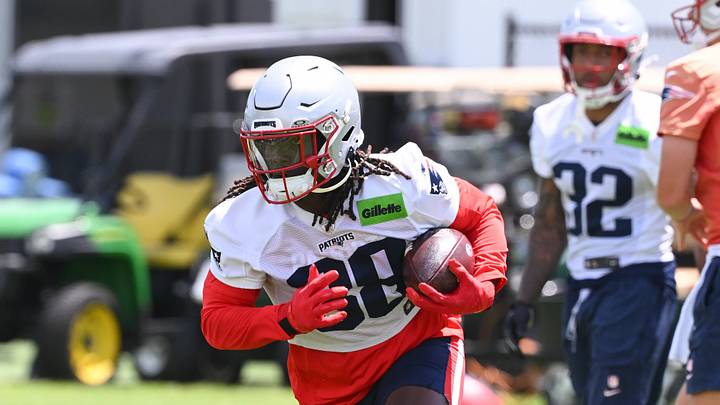
Eliot Wolf didn't exactly follow in his predecessor's footsteps by paying big money to keep a running back around in Foxboro. After all, Bill Belichick typically took the "next man up" route by transitioning from LeGarrette Blount to Sony Michel to Damien Harris (and then Stevenson) without batting an eye.
However, one of the first moves Wolf made after essentially inheriting GM duties from his former boss was signing Rhamondre Stevenson to a four-year, $36 million contract extension with $17 million guaranteed. Needless to say, spending $9 million a year on a running back coming off an 801-yard season was a bold move, especially given the state of the franchise at that time.
Fast forward nearly a year later to the 2025 NFL Draft, and the Patriots — coming off consecutive 4-13 seasons and facing huge pressure to surround Drake Maye with an acceptable supporting cast —entered the second round with a chance to add a playmaking wide receiver or even a second offensive lineman after using their top pick on Will Campbell.
Instead, Wolf and the rest of the team reportedly made the unanimous decision to use the 38th selection on Ohio State's TreVeyon Henderson. He was actually the second Buckeyes back to come off the board, as the Cleveland Browns selected Quinshon Judkins 36th overall.
An electrifying playmaker with some size and durability concerns, Henderson represented an obvious speed and explosion upgrade. However, questions arose about whether using such a prime pick (or failing to trade down, at least) on a running back who wasn't viewed as an every-down type of player was the best use of resources. Plus, the team had just invested in Stevenson, a move that didn't look great after the first and only year of the tumultuous Jerod Mayo "era" as head coach.
Luckily for Wolf, the Henderson pick paid immediate dividends for a Patriots team that went from worst to first in Mike Vrabel's debut season as head coach. Unfortunately for Wolf, his decision to make Stevenson among the league's highest-paid running backs (he currently ranks 14th in average annual salary in light of recent extensions) looked even worse in the wake of the veteran's fumbling problems in 2025.
Although Stevenson rectified the issue and became a key cog in the offense down the stretch, there's no doubt he's failed to provide the production the Patriots expected when they extended him two summers ago.
The pressure is officially on for New England's backfield duo
Heading into the 2026 season, there are several reasons to be optimistic about the Patriots' backfield. On one hand, Henderson flashed tremendous potential as a rookie, finishing with over 1,100 total yards from scrimmage. However, he didn't quell concerns about his ability to be a true every-down, between-the-tackles runner, and his pass-blocking struggles forced the Patriots to rely more on Stevenson down the stretch.
Considering his draft status, however, Henderson can't just be a gadget player who touches the ball a handful of times per game. That number should be between 10 and 15, and you could argue he should be the team's top kickoff returner.
Meanwhile, Stevenson enters the third year of his big-money extension coming off yet another underwhelming campaign. The 28-year-old finished with a mere 603 rushing yards, the fewest of his five-year career. While he's well-respected in the locker room and by the coaching staff, his lack of production simply can't be overlooked.
At the same time, this is a player who has looked like a true do-it-all workhorse at times since he entered the league as a fourth-round pick in 2021. And you have to give Stevenson credit for remaining cool, calm, and collected during the final ugly years of the Belichick era and his lone season playing for Mayo.
On paper, the Stevenson-Henderson duo has that "thunder and lightning" potential. That explains why they ranked 10th in Warren Sharp's 2026 running back rankings, as the theoretical pairing possesses big-time upside. Plus, the improvements the Patriots made along the offensive line should pave the way for more production out of the backfield.
Here's what Sharp wrote about the pairing:
"We were all over the map in our ranking of the Patriots' backfield, with votes ranging from fifth to 17th. The differing opinions might stem from the stark contrast of TreVeyon Henderson’s and Rhamondre Stevenson’s success in the regular season compared to their combined 3.3 yards per carry in the playoffs."
Potential won't be enough in 2026
That being said, potential is a scary word to use, especially when there's a track record to go off of.
As much as Stevenson may look the part, he's had one 1,000-yard rushing campaign in five seasons. That certainly doesn't warrant a $9 million average annual value.
Meanwhile, Henderson has to prove he can be trusted on third downs to keep his quarterback out of harm's way. And he also has to show he can be patient enough to let the blocking develop in front of him before he hits the hole and flashes his breakaway speed.
If Henderson doesn't improve in both areas, that'll make the whole conversation about the supposed franchise-altering 2025 draft class quite interesting. After all, there are legit questions about whether Will Campbell can cut it at left tackle or whether he'll have to move to guard. Third-rounder Kyle Williams made some splash plays, but he faces an uphill battle to break the trend of highly drafted receivers who fail to figure it out in Foxboro.
Ultimately, when you look at Wolf's brief tenure as the team's chief decision-maker, hitching his wagon (and Robert Kraft's wallet) to Stevenson, and spending a high second-round pick on a player who may be more of a specialty piece than a featured back, could end up hurting the team more than helping.
 Add us as a preferred source on Google